ADATA and MSI have jointly announced the world-first 4-rank CUDIMM DDR5 memory module which crams a whopping 128 gigabytes of memory chips on a single DDR5 stick, while simultaneously capable of stable operations at 5600MT/s as verified on MSI’s Intel Z890 motherboard.
ADATA & MSI Brings “World’s First 4-Rank Design” Memory
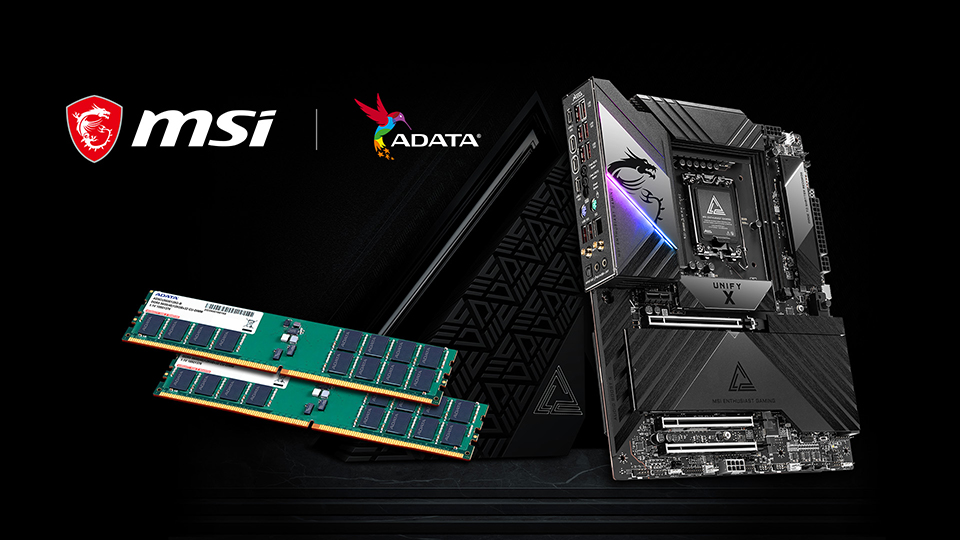
Today, conventional consumer-grade memory modules are single-rank or dual-rank designs depending on capacity, while 4-rank is often difficult to achieve as memory controllers are stressed harder than usual, meaning it won’t handle clock speeds as fast as dual-rank and single-rank configurations do. That’s where CUDIMM comes in: on typical implementations, CUDIMM modules often exceed well beyond 8000MT/s in dual-rank configuration, and implementing them into 4-rank modules have similar effects, too.
ADATA says the modules have undergone integration and testing on MSI’s “in-development Z890 motherboards,” completing stable burn-in verification at 5600MT/s while maintaining “excellent compatibility, performance, and stability.” MSI’s announcement also mentioned the single-rank configuration of this module managed to complete stability burn-in at over 10,000MT/s – a speed currently not yet achieved on stock CUDIMM modules.
With this, motherboards with dual-slot DIMM configurations (i.e. overclocking-focused boards like ASUS ROG Maximus Z790 Apex or GIGABYTE X870 AORUS TACHYON ICE, and some micro-ITX models like MSI MPG B850I EDGE TI WIFI) can access up to 256GB of capacity with just two sticks of RAM, and it also helps alleviating the performance trade-offs associated with 4-stick RAM configurations.
Both companies hasn’t stated anything regarding retail release so far, although it is likely that they will launch near or alongside a new batch of refreshed Intel Z890 motherboards as there are no signs that Intel 900-series motherboards is coming any time soon (and Nova Lake, which is expected to be using this future lineup, likely isn’t happening until 2027).
Pokdepinion: The only issue is the price – and you really don’t want to look at today’s DRAM pricing. (Hint: it’s really bad, thanks to AI’s demands.)


![[UPDATED: Statements] Forza Horizon 6 Dev Drops Multi-Millennial Ban Hammer To Cheater Before The Game Has Even Released - 58](https://cdn.pokde.net/wp-content/uploads/2026/05/12022254/fh6leakpermabancover-420x280.jpg "[UPDATED: Statements] Forza Horizon 6 Dev Drops Multi-Millennial Ban Hammer To Cheater Before The Game Has Even Released - 59")