“I’m Not A Robot”: Study Says Robots Solve CAPTCHAs Better Than Humans
“I’m Not A Robot”: Study Says Robots Solve CAPTCHAs Better Than Humans

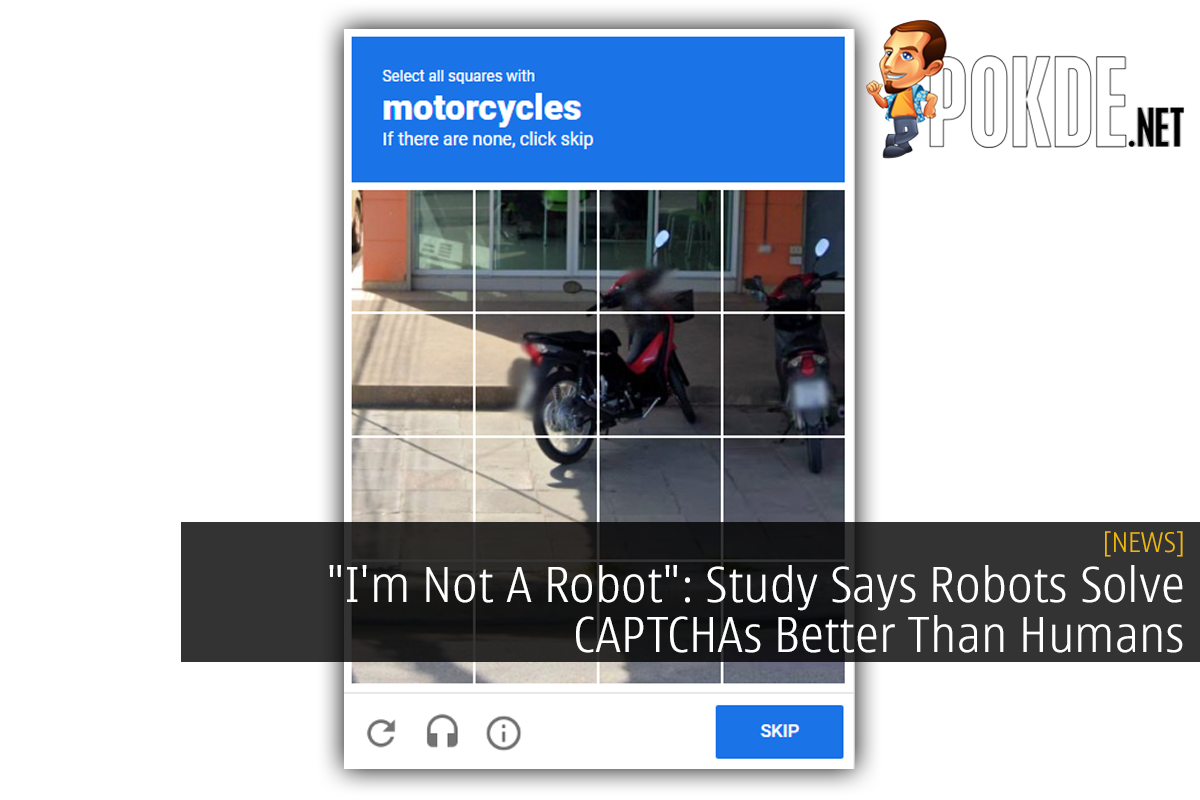
You certainly has seen CAPTCHAs before – short form for Completely Automated Public Turing test to tell Computers and Humans Apart – those questionnaire that you at some point has stumbled when visiting a website, to prove that you are a real human accessing it, instead of a robot.
It is designed to protect websites from bots that spams and overloads the website’s servers, by creating a challenge that is relatively easy for humans to solve, which robots weren’t able to do so (such as typing certain characters or distinguishing objects from an image).
However, this system is designed all the way back in 2000 – and systems has gotten a lot more powerful ever since, especially as AIs has gained impressive power to recognize text in ways that was previously impossible. Researchers at the University of Irvine has published a paper that says CAPTCHAs only proved to make life difficult for humans, while being powerless against bots. The test compared the performance of 1,400 humans and bots in 14,000 tests. The result? Bots won, and by a significant margin.

One common type of CAPTCHAs is distorted text, where users are asked to type what they see in the warped or partially obfuscated image. While humans can solve the challenge in 9 to 15 seconds, bots ripped through it in less than a second. Worse yet – humans achieved 50-84% accuracy, whereas bots hit a near-perfect 99.8% accuracy.
The study’s co-author, Prof. Gene Tsudik said: “Based on our study’s extensive measurements of many participants’ CAPTCHA-solving times, we can confidently say that most humans are slower than bots. That is a new result.” He pointed out that a better solution is needed to replace “a technology that is almost universally disliked, costs so much (time), and is ineffective against bots”.

However, some has pointed out that certain types of CAPTCHAs worked the other way around – by checking if the action taken (such as clicking the checkbox) is deemed too fast to be performed by humans. This is commonly seen in Google’s reCAPTCHA systems. There’s another variation of Google’s solution that does away with the test entirely – and instead rely on website interactions (such as clicking, scrolling and mouse movement).


Source: PCMag
Pokdepinion: I have definitely spent way too much time dealing with image-based CAPTCHAs one time – and I don’t remember how long it was…




![[UPDATED: Statements] Forza Horizon 6 Dev Drops Multi-Millennial Ban Hammer To Cheater Before The Game Has Even Released - 62](https://cdn.pokde.net/wp-content/uploads/2026/05/12022254/fh6leakpermabancover-420x280.jpg "[UPDATED: Statements] Forza Horizon 6 Dev Drops Multi-Millennial Ban Hammer To Cheater Before The Game Has Even Released - 63")