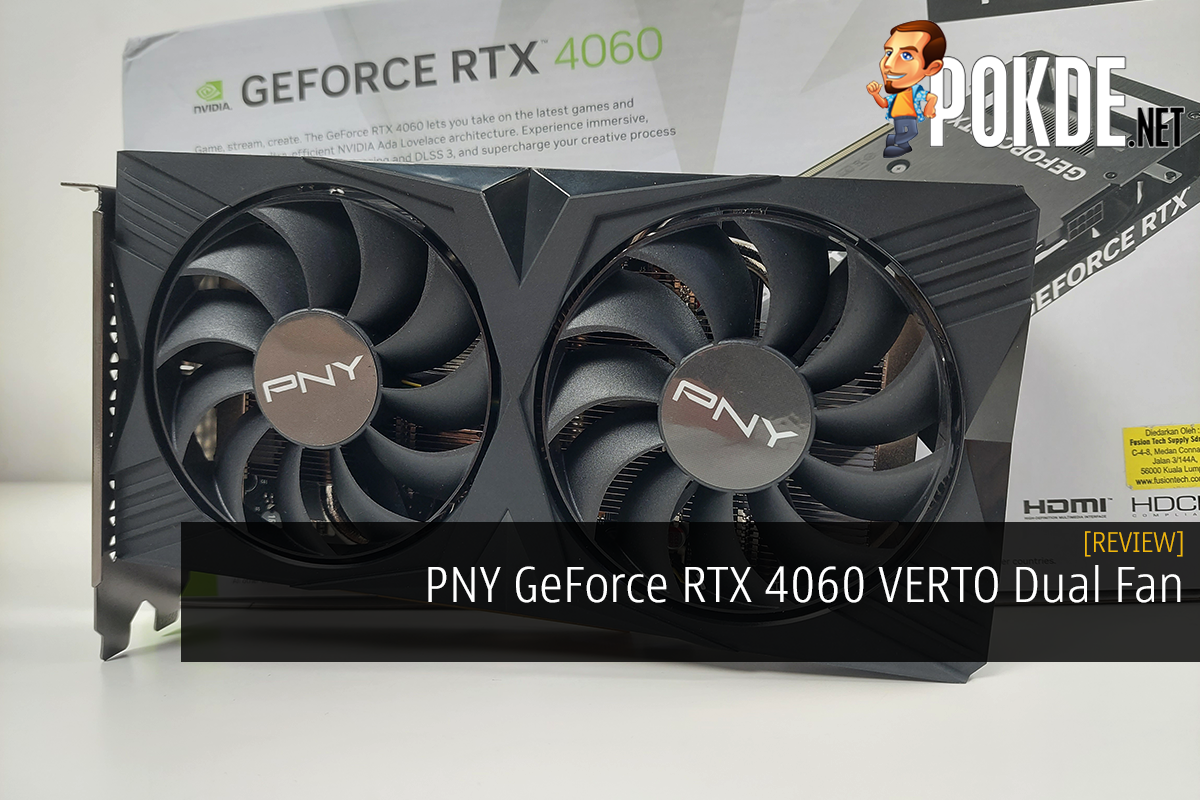
PNY GeForce RTX 4060 VERTO Dual Fan Review – Subtle And Silent
-
Appearance - 8.2/10
8.2/10
-
Efficiency - 9/10
9/10
-
Features - 8.2/10
8.2/10
-
Materials - 8.2/10
8.2/10
-
Performance - 7.8/10
7.8/10
-
User Experience - 8/10
8/10
-
Value - 8.3/10
8.3/10
Summary
The PNY GeForce RTX 4060 VERTO Dual Fan represents a small improvement in performance in general, though what you get is a huge reduction in power draw.
Overall
8.2/10Pros
+ Impressive power efficiency
+ Quiet fans
+ Small GPU footprint
+ Decent value
Cons
– Lacks VRAM temperature sensor
– Erroneous power draw sensor reporting effectively prevents 0dB mode from activating
– 8GB VRAM may not age well
Today we have the NVIDIA’s lowest-end GPU on the RTX 40 series so far – the RTX 4060 (courtesy of PNY). Compared to predecessors, this particular silicon is a bit unusual: it uses 107-class die that usually was reserved for 50-class GPUs, and as a result it’s very tiny in size while using very little power. On paper, this looks like Team Green’s way of saving costs – not that they lack cash right now, given their AI dominance – but what about the performance? Let’s find out.
Unboxing

Our unit of the PNY GeForce RTX 4060 VERTO Dual Fan is provided by Fusion Tech Supply Sdn Bhd (FTSMY), and in the retail units you are expected to see the sticker that provides you two free gifts with the purchase of this GPU.

The standard PNY RTX 4060 packaging contains only the GPU and the quick install guide; however, as mentioned you’ll be getting two gifts – one is a free Slev.30 ATX 24-pin + PCIe 8-pin braided cable, while the second gift is a free Ubisoft game of your choice among six options.
Appearance


As for the GPU itself, it’s not that much different than other VERTO Dual Fan designs, with the black plastic shroud that is slightly shorter than the RTX 4070 VERTO Dual Fan. Unlike its more powerful cousin, however, is the presence of ring blades that reduces turbulence and increase airflow pressure – a feature more commonly seen in higher-end GPUs.


Another distinct design choice of the RTX 4060 VERTO is the heatsink: usually, the heatsinks are aligned vertically relative to the GPU; however, this card rotates it sideways instead. Based on our observations, the airflow is still mostly directed to the top (probably due to airflow getting blocked on the bottom side when installed onto the motherboard, thus forcing the air out this way in high airflow/pressure conditions), with little amounts of air pushed sideways.

Cutouts are common on modern GPUs these days, though its use here are arguably limited – as the majority of the cutout reveals nothing but negative space. It’s also worth noting that this GPU utilizes PCIe 4.0 x8 connection on a x16 connector – but that’s no concern as the performance simply wouldn’t saturate the PCIe bus anyway.


Nothing unusual on the display outputs – they’re pretty much standard layout as with NVIDIA’s own designs. That means you’re getting three DisplayPort 1.4 outputs paired with a single HDMI 2.1 port capable of delivering high-refresh 4K displays, or 8K60 displays.
Specifications
PNY GeForce RTX 4060 VERTO Dual Fan
| GPU Core & VRAM: NVIDIA GeForce RTX 4060 |
|
| GPU Core Variant | AD107-400-A1 |
| Microarchitecture | Ada Lovelace |
| Process Node | TSMC N5 |
| Transistors | 18.9 billion |
| Die size | 159mm² |
| Streaming Multiprocessors (SMs) | 24 |
| CUDA Cores | 3072 |
| Tensor Cores | 96 |
| RT Cores | 24 |
| Cache | 24MB L2 |
| VRAM Configuration | 8GB GDDR6 128-bit |
| Memory Bandwidth | 17Gbps, 272GB/s peak |
| Add-in board: PNY GeForce RTX 4060 VERTO Dual Fan |
|
| Base/Boost Clock | 1830 / 2460 MHz |
| TDP | 115W |
| Recommended PSU | Unspecified |
| Dual BIOS Mode | No |
| Display Outputs | 3x DisplayPort 1.4 1x HDMI 2.1 *Max output resolution: 7680×4320@60Hz |
| Power Connector | 1x 8-pin PCIe connector |
| Bus Interface | PCIe 4.0 x8 |
| Dimensions | 2-slot, 210 x 115 x 39.9 mm |
Test System
| CPU | Intel Core i9-13900K |
| Cooling | Cooler Master MasterLiquid PL360 Flux 30th Anniversary Edition Cooler Master MasterGel Maker |
| Motherboard | ASUS ROG Maximus Z790 HERO |
| GPU | PNY GeForce RTX 4060 VERTO Dual Fan |
| Memory | Kingston FURY RENEGADE RGB DDR5-6400 CL32 (2x16GB) |
| Storage | Samsung SSD 980 PRO 256GB (Boot) Kingston NV1 1TB |
| Power Supply | Cooler Master MWE Gold 1250 V2 Full Modular 1250W |
| Case | VECTOR Bench Case (Open-air chassis) |
| Operating System | Windows 11 Home 22H2 |
Performance
All benchmarks are done in out-of-the-box settings, unless otherwise specified. Games are tested under these settings (upscaling features such as NVIDIA DLSS, AMD FSR or Intel XeSS are turned off, unless otherwise specified):
- Forza Horizon 5 (RT ON)
Maximum settings (all settings maxed out to EXTREME preset when available, Ray Tracing set to EXTREME). - Forza Horizon 5 (RT OFF)
Ultra High preset – Ray Tracing turned off. - Red Dead Redemption 2
All settings set to ULTRA – slightly higher quality over ‘Favor Quality’ from the in-game settings slider. - Shadow of the Tomb Raider (RT ON)
HIGHEST preset. RT Shadows set to ULTRA (which overrides default Shadow settings). - Shadow of the Tomb Raider (RT OFF)
Same as the previous run – with the exception of RT Shadows turned OFF, with Shadow settings set to ULTRA instead. - F1 2022 (RT ON)
ULTRA HIGH preset. Ray Tracing is set to HIGH under this preset.
Synthetic Benchmarks

For the benchmarks, we’re putting the PNY RTX 4060 VERTO against two of its contemporary rivals: Team Red’s Radeon RX 7600 and Team Blue’s Arc A750. Quick reference: the AMD GPU consumes 165W on full load, whereas Intel Arc A750 LE runs 190W stock. The GeForce RTX 3060 meanwhile consumes 160W, and our test subject is merely sipping 115W while keeping up with the rest – making it vastly more efficient considering the numbers it achieved as seen in the chart above.
Gaming – 4K (3840 x 2160)

Next up is the “torture test” for mid-range GPUs, with games on 4K resolutions. F1 2022 presents the worst case scenario with graphics cranked up to Ultra High quality, which all cards struggled to keep up. Same applies to SOTTR – though in both cases the RTX 4060 managed to stay ahead of the pack. The highlight goes to Forza Horizon 5 with RT off – in this case, the RTX 4060 scored a clear lead over the rest, hitting 60FPS average in 4K (with no DLSS/FSR assistance at that, too). Not bad!
Gaming – 1440p (2560 x 1440)

It looks like the large cache pool available for the RTX 4060 has given the GPU even more grunt in lower resolution, where cache misses occurs less – that converts to higher effective memory bandwidth. Take SOTTR as example – in 4K, the GPU had a miniscule lead; here in QHD resolution it’s able to pull away by a significant margin. The same trend also applies to Forza Horizon 5 with maxed out settings.
Gaming – 1080p (1920 x 1080)

It’s worth noting that despite RTX 4060’s dominance in virtually all games and scenarios here in 1080p resolution, there’s one exception – Red Dead Redemption 2. Traditionally, this game (and by extension, Rockstar’s RAGE engine) seems to be less friendly with NVIDIA’s GPU architecture in general (or just adapts better towards Intel and AMD GPUs), so the card at no point has scored a lead in all three resolutions, leaving the win to either Intel or AMD.
Thermals

Up next is thermals – and for a 60-class GPU that sips such little power, this seems like a good sign. In any case, here’s the results.


The 10-minute Furmark stress test does present some interesting data for the PNY RTX 4060 VERTO GPU. For one, there is an initial spike that briefly exceeds the GPU’s stock 115W TGP limit, and like its predecessor – it lacked the VRAM sensor, for some reason. Either way, the core temperature is relatively well-controlled at around 68°C (hot spot 78°C), so VRAM temps shouldn’t be an issue. In terms of fan speeds, it starts out at around 1100 RPM, though there’s an unfortunate reason for it, which we’ll explain below.


The Time Spy Extreme stress test (10 runs) reveals highly fluctuated sensor readings, both in power draw and core temperature. However, the average temperature is more or less the same as the Furmark run – with core temperature averaging in the high 60s, while the hot spot temperature peaked at 85°C; while the power draw peaked at 133.3W at one point.
For some reason, which we think is a bug on NVIDIA’s part – the power draw sensor always reads the power draw at around 52 watts when it’s idle – even though the GPU is physically not heating up at all (core temperature is near ambient, in the low 30s). That erroneous sensor value in turn caused the fan speed to never enter 0dB (fan stop) mode since it thinks the GPU is in use and will turn up the fans to cool it down, despite the fact that there’s no GPU load. This is also reported on RTX 4060 GPUs from other vendors, so it’s not an issue on PNY’s side.
Software

PNY’s software of choice is called VelocityX VERTO, and it offers plenty of features from monitoring to tuning the GPU. There’s also RGB lighting options available, but since the RTX 4060 VERTO has no onboard RGB to begin with, it’s hidden from the app.
Warranty

For warranty, you can contact either Fusion Tech Supply Sdn Bhd (PNY’s local distributor), or PNY Malaysia – as long as you see the yellow sticker pictured above.
Conclusion

Some say that RTX 4060 in some ways are pretty much a hypothetical “RTX 4050” given the specs on paper – and to some extent, I agree. The silicon inside this GPU is the smallest among the 60-class GPUs from Team Green, but it felt like a wasted potential. Just imagine for a second, what happens when RTX 4060 is when it’s given the AD106 chip. (Hint: the answer lies on the RTX 4060 Ti 8GB.)
Still, that’s just naming issues if anything, and some will point out that names are just arbitrary; it’s the performance that matters. Which, I do find it a bit underwhelming because of the bar that NVIDIA has set for its higher-end models. All of that big 50%+ increases are only reserved for something like RTX 4090 or RTX 4080, and honestly the RTX 4060 could’ve done more. Perhaps something like a 150W instead of 115W would’ve make this GPU a whole lot more enticing.

To be fair, the card is capable – it managed to mostly outpace all contemporaries with just two-thirds of power, and that in itself is an impressive feat. That, of course, provides the knock on effect that you’ll be able to cool the card more easily, or that GPUs can get even smaller than this, possibly even in a single-fan form factor.
Let’s get back to the PNY’s part for a bit. For what it’s worth, the PNY RTX 4060 VERTO does the job like all the VERTOs that come before it, nothing out of the ordinary (if you ignore the sensor bug which technically isn’t PNY’s fault). The price? RM1,519. Compare to something like Intel Arc which costs around RM200 less, the value is more on Team Blue’s side; however, whether you’d see this RTX 4060 GPU being at half the price of RTX 4070 as a steal is entirely up to your interpretation. Value is relative, remember!

You can purchase this GPU by clicking on this link.
Thanks to PNY Malaysia for providing us the GeForce RTX 4060 VERTO Dual Fan for this review.